“Future Faking” in Relationships: Why It Happens and How to Spot It


You’re only a few dates in, and somehow the conversation has already drifted to weekend trips you’ll take together, holidays you’ll spend with each other’s families, and the neighborhood you might one day share. It feels romantic, maybe even like a sign that this one is different. But what if those words are doing something else entirely? What if they’re not promises at all, but bait?
“Future faking” in relationships is the practice of making premature promises about a shared future in order to secure emotional investment in the present, and according to new survey data from Tawkify, it’s far more common than most people realize. This is the quiet epidemic of modern dating, and most people don’t recognize it until after the damage is done.
Key Takeaways
- More than 9 in 10 singles (92%) have experienced future faking, but only 30% had heard the term before.
- “We” and “us” is the #1 future-faking tell. Half (50%) of singles heard it early on, ahead of long-term commitment talk (47%) and trip planning (46%).
- More than half of singles (55%) say long-term future talk started within the first 3 dates, and 17% heard it before or during the first date.
- 2 in 5 singles (40%) admit to using future-oriented language themselves before they were actually sure about the relationship.
- 64% of future-faked relationships collapsed within one month of the promise, and 26% dragged on 2+ months before the lie became clear.
- Tinder topped the list of apps where singles experienced future faking (28%), followed by Bumble (19%) and Hinge (19%).
- Women are hit hardest: 68% trust new partners less (vs. 47% of men), 45% now view past future talk as misleading (vs. 19%), and 34% call early future talk a red flag (vs. 15%).
In this article
How Fast Early Future Talk Shows Up in Modern Dating
It doesn’t take long. For most singles, the future talk starts before they’ve even had a chance to figure out if they actually like the person sitting across from them.
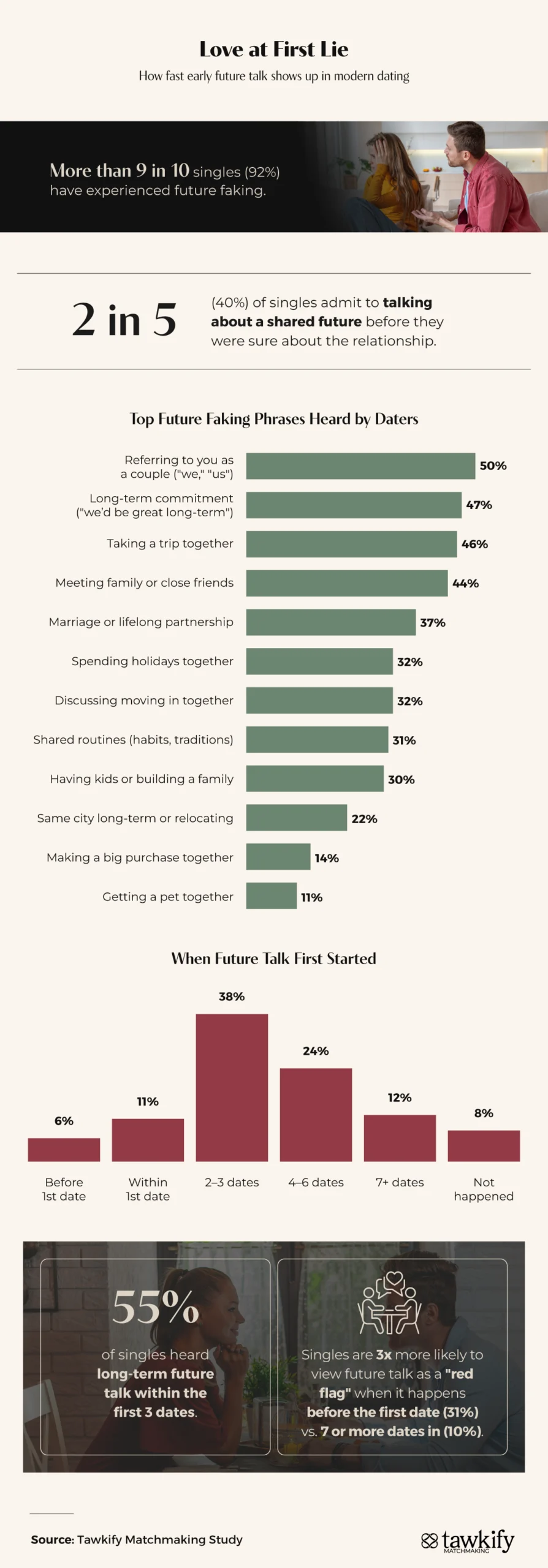
Future faking in relationships is nearly universal and largely unrecognized. More than 9 in 10 singles (92%) said they’ve experienced it, yet 65% had never heard the term before taking this survey. Two in five singles (40%) also admitted to using future-oriented language before they were actually sure about the relationship.
More than half of singles (55%) heard long-term future talk within the first three dates, with 17% encountering it before or during the very first date. The most common tell is also the subtlest: being referred to as a couple (“we” and “us”), which 50% of singles heard early on.
Gen Z singles were the most likely to hear marriage talk early in dating (44%), compared to 36% of Gen X and 34% of millennials. Just 19% of all respondents recognized early future talk as a red flag at the time, while 32% now view it as misleading in hindsight. Women were more than twice as likely as men to reach that conclusion (45% vs. 19%).
Where Future Fakers Say They’ll Take You
Talking about travel is one of the most common forms of future faking in relationships. The top 10 cities singles were promised a trip to included:
- Las Vegas
- New York
- Paris
- Miami
- Los Angeles
- London
- Bali
- Dubai
- Orlando
- Chicago
Overall, 31% of respondents named a U.S. destination, while only 25% named an international one. Gen Z was most likely to say they were promised a trip to New York (11%), Japan (9%), and Paris (5%). Millennials and Gen X more often heard plans about visiting Miami, Vegas, California, and the Caribbean.
Men were more likely than women to have been promised international bucket-list spots like Paris (5%), Japan (4%), and London (4%). Women were promised Vegas (9%) and Miami (8%) at roughly double the rate of men.
How Quickly Future Faking Collapses (and Who Breaks the Promise)
The promises come fast. The collapse, for most people, comes even faster, and it rarely ends with a real conversation.
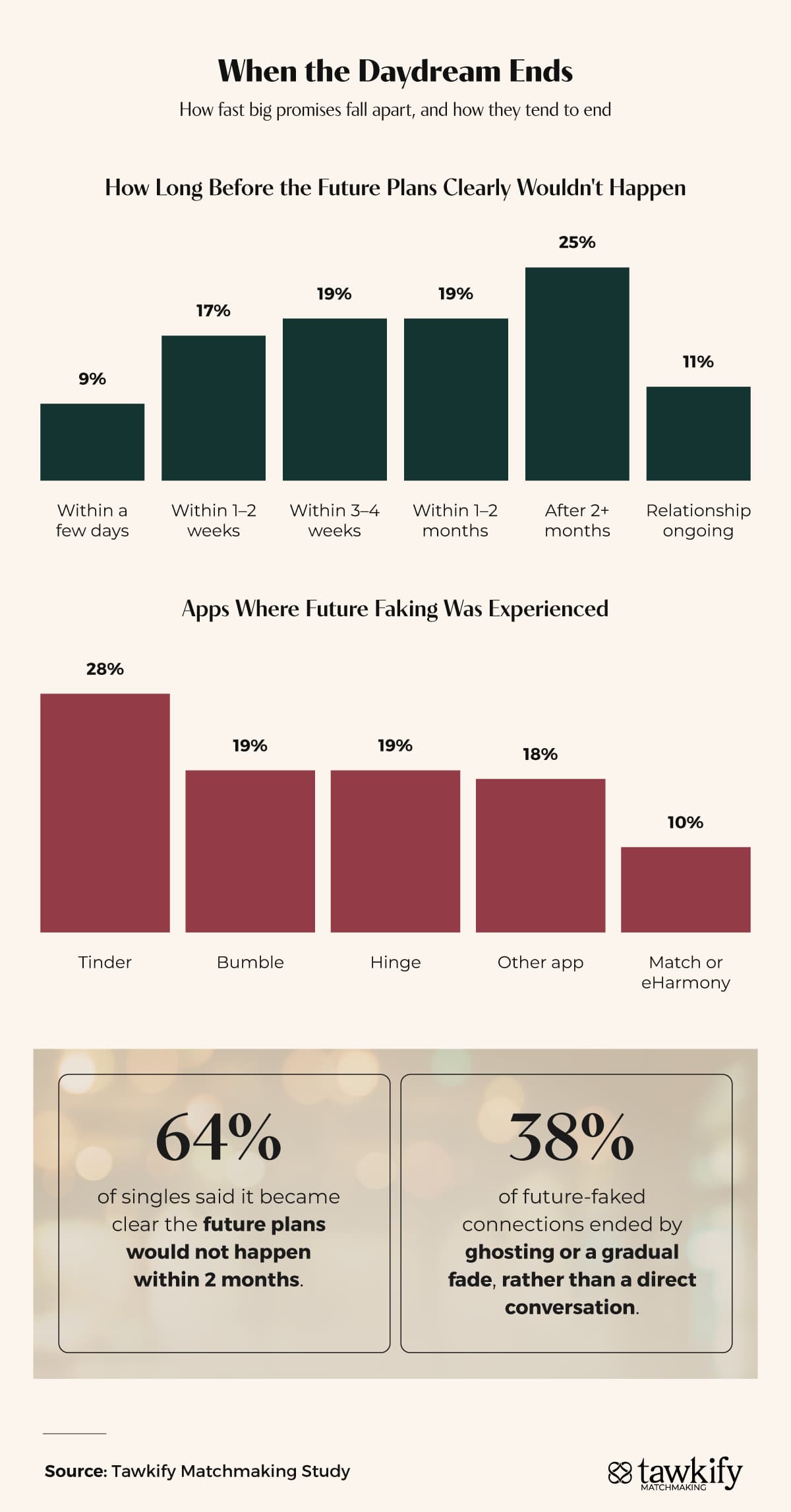
Most future-faked relationships don’t last. Nearly two-thirds of singles (64%) said the illusion collapsed within one month of the promise being made. Another 26% said the future talk dragged on for two or more months before it became clear nothing was going to materialize.
When it does end, closure is rarely part of the deal. Only 25% of future-faked connections ended with a direct conversation, compared to 38% that ended in ghosting or a gradual fade. Just 13% of future-faked connections turned into stable relationships.
How it ends also breaks down differently by gender:
- Men were more likely to report a gradual fade (33% vs. 24% of women).
- Women were more likely to report being ghosted (13% vs. 8% of men).
Tinder was the most-named app where singles experienced future faking (28%), and Gen Z was nearly four times more likely than Gen X to have experienced it on Hinge (31% vs. 8%).
When you’re looking for a relationship, there’s no comparison
Tired of swiping with no real connections? Tawkify takes a fresh approach to the process. With handpicked matches tailored just for you and personalized introductions, we do the work so you can focus on what matters — meaningful connections.
- 80% of people find success with Tawkify
- 3 Million+ relationship-ready singles
- 200,000 Successful connections and counting
How Future Faking Reshapes Trust, Dating Behavior, and Relationship Outlook
The broken promise is just the beginning. What lingers long after the relationship ends is a quieter kind of damage: a recalibrated sense of trust, a new wariness about vulnerability, and for some, a partial withdrawal from dating altogether.
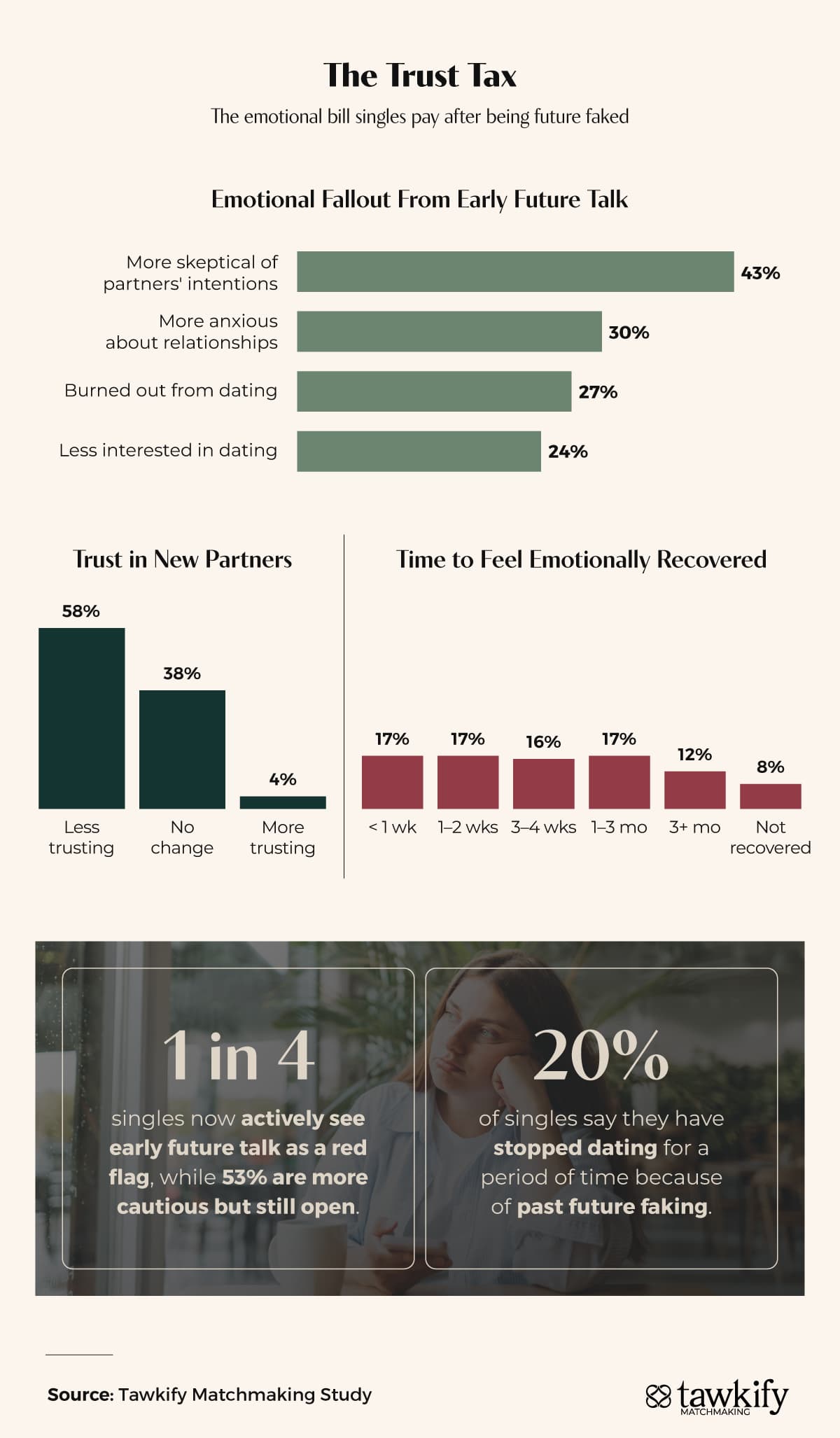
The trust damage of future faking in relationships is widespread. More than half of singles (58%) trust new partners less after past future-talk experiences, and 46% are now more cautious about trusting what dating partners say. Only 25% actively see early future talk as a red flag, but 53% describe themselves as more cautious and still open. Gen X was most likely to actively label early future talk a red flag (36%), compared to Gen Z (23%) and millennials (20%).
Recovery isn’t quick, either. More than a third of singles (37%) said it took one or more months to emotionally recover, and 8% haven’t fully recovered at all. One in five (20%) stopped dating entirely for a period of time because of it. Gen Z was most likely to now feel more anxious about relationships (38%), compared to millennials (31%) and Gen X (22%).
Where future faking happens also shapes how badly it lands. Future faking that starts in person is twice as likely to become a real relationship compared to dating apps (19% vs. 9%). Apps also see the highest ghost-or-fade rate at 46%, compared to 31% for in-person connections.
The emotional toll isn’t evenly distributed across genders. Women reported a heavier impact than men across every measure:
- 68% less trusting (vs. 47%)
- 52% more skeptical of partners’ intentions (vs. 33%)
- 34% now see it as an active red flag (vs. 15%)
- 30% are less interested in dating (vs. 18%)
Recognizing the Pattern
Future faking in relationships thrives on a gap between words and intention, and on the very human tendency to want those words to be true. The good news is that awareness is its own form of protection. When 9 in 10 singles have been through it, this is no longer a niche problem or a personal failing. It’s a structural feature of how modern dating tends to unfold, especially on apps where superficial intimacy comes easy and accountability comes hard.
Paying attention to the pace of future talk — how soon it arrives, how specific it is, whether it’s accompanied by consistent action — is one of the clearest ways to distinguish genuine connection from a well-crafted illusion. And for those who are tired of trying to decode the signals on their own, there’s something to be said for a process built around intentionality from the start.
Tawkify’s matchmakers do exactly that. We pair singles with compatible partners who are equally serious about finding something real, not just saying the right things early on. Find out if matchmaking makes sense for you.
Methodology
We surveyed 1,023 people who are currently dating to understand how early “future talk” in dating shapes trust, emotional well-being, and how people approach relationships. The survey examined how often respondents have been on the receiving end of future-oriented promises that never materialized, and whether they’ve used that same language themselves before being sure of a relationship.
The average age of respondents was 38. The gender breakdown was 51% women, 47% men, and 2% nonbinary or not listed. Millennials made up the largest share of respondents (50%), followed by Gen Z (24%), Gen X (21%), and baby boomers (4%). Most respondents meet dating partners in person (43%), while 29% use a mix of in-person and dating apps, and 28% rely primarily on apps. The survey was conducted online in April 2026.
About Tawkify
Tawkify is a human-first matchmaking service built for people who are serious about finding lasting love and done with leaving it to algorithms. Where dating apps reward volume and surface-level swiping, Tawkify offers a deeply personalized, expert-curated experience designed to introduce you to compatible partners who are equally invested in building something real. If future faking has left you wary of putting your trust in yet another stranger, Tawkify’s matchmakers are here to help you date with intention and finally skip the guesswork.
Fair Use Statement
We encourage the free sharing of this data for editorial and educational purposes. If you use this research, please attribute it to Tawkify and link back to this page so your readers can access the full findings.